What an API Is Without Jargon

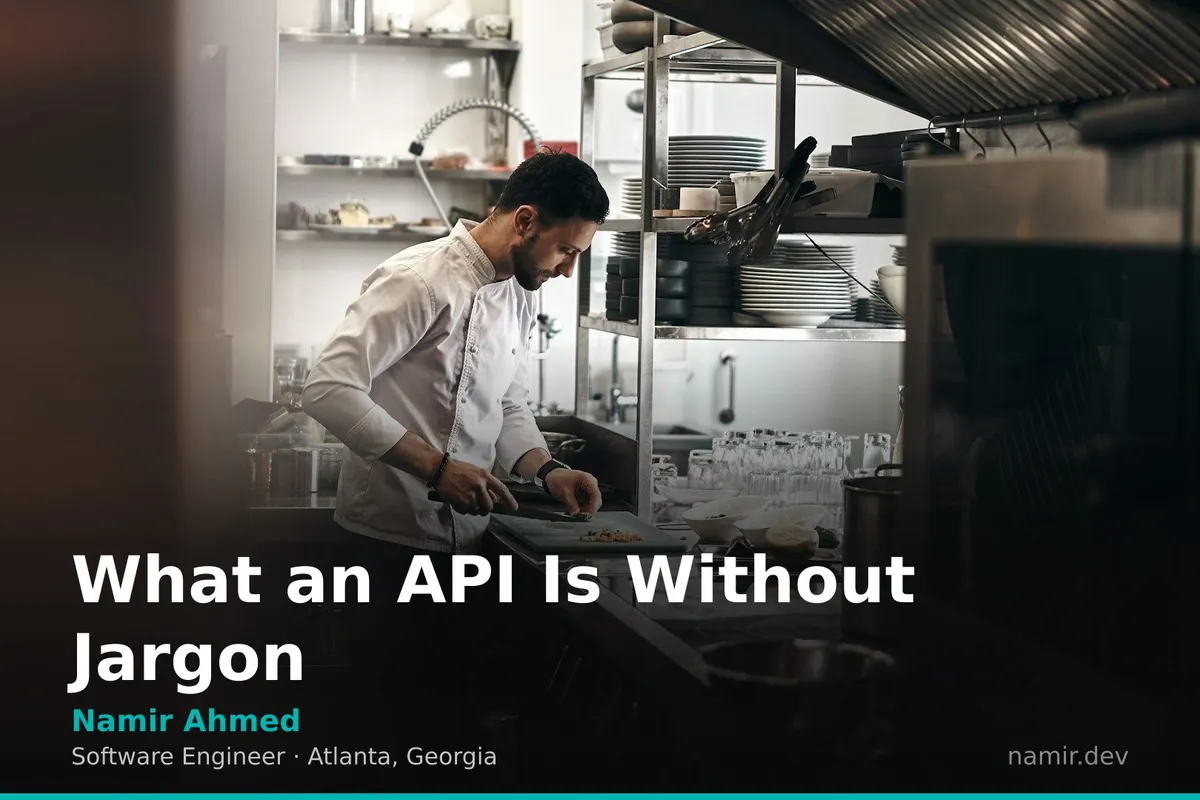
Cover photo by Pylyp Sukhenko on Unsplash
Do you really need to know what an API is? You’ve heard the term thrown around by everyone from product managers to junior devs, and it usually sounds like a mystical gatekeeper for your code. It isn’t. An API is just a way for two programs to talk to each other. That is the whole thing.
The restaurant analogy works
Think of a restaurant. You are at the table, you want a burger, but you cannot just walk into the kitchen and start throwing ingredients onto the grill. You would get kicked out (and honestly, you would probably burn the kitchen down). Instead, you look at the menu, tell the waiter what you want, and they bring it back to you. The waiter is the API.
They take your request to the kitchen (the server), the kitchen makes the food, and the waiter brings it back to your table. You do not care how the chef cooks the steak, you just care that your order arrives. The menu is the documentation. It tells you what you can order and what the result will be.
Here is what it looks like in code
When you build or use an API, you are just defining an endpoint where one service can send data and get a response. Usually, this looks like a JSON object. Here is a simple example in JavaScript:
// Requesting user data from a hypothetical APIfetch('https://api.myapp.com/users/1') .then(response => response.json()) .then(data => console.log(data.name));That is it. You asked for user number one, and the server handed you back a package with the name inside. You don’t have to worry about the SQL queries, the database connection pools, or the caching logic happening on the other side of that request (though honestly, you should probably care a little bit about those eventually).
But wait, isn’t it more complex than that?
“You are oversimplifying! What about authentication, rate limiting, and status codes?” I hear you. You are right that production APIs are messy. Security, error handling, and latency are real problems you will eventually deal with once you start building systems that actually matter.
However, before you dive into the deep end of OAuth or gRPC, you have to realize that at the most basic level, it is still just a conversation between two computers. It is just structured, predictable, and automated communication.
I admit that my analogy breaks down if you think about complex streaming data or real-time sockets (where the kitchen keeps throwing food at you without you asking), but for 90 percent of the web, this simple mental model keeps me grounded. If you get bogged down in the terminology, just remember the waiter. Stop treating the API like a black box and start seeing it as a predictable exchange of information.